Sunday, May 2, 2010

Give Them a Fighting Chance

Pretend you’re seven-years-old. Your life consists of chasing bubbles and playing hide-and-go-seek. Your biggest concern is whether or not your mom remembered to pack your pudding cup for lunchtime. You’re an All-American kid. Maybe you even have a pet dog named Fido, or Sparky, or Spot.
For most of us, our childhood was pretty good. We didn’t really have any big worries. Sadly, however, this is not the case for all of today’s children. About 300,000 children are primary combatants in more than 75 percent of the world's conflicts. Globally, children are singled out for recruitment by both armed forces and armed opposition groups, and exploited as combatants. These kids are coerced through physical force or manipulation to commit horrifying crimes such as rape and murder. Some are forced to injure or kill members of their own families or other kids who have been recruited. Others serve as cooks, guards, and sex slaves. Still others are assigned jobs as spies and messengers because people don’t suspect kids as being part of the enemy’s army. Below is a map of all the countries that use child soldiers.


As horrifying a life as these kids lead, not all child soldiers are forced by the military to join. Some kids voluntarily join because they have no family or they don’t have any other way of receiving food, water, or shelter. Some families offer up their children, especially for suicide missions where they will be martyred because it is seen as honorable for them to fight or die for a certain cause or because their religion glorifies martyrdom.


When thinking about child soldiers, images of kids like Ishmael Beah from the above video are the ones that most readily come to mind. We think of little boys running around with machine guns, but what most people don’t know is that forty percent of child soldiers are girls. Granted, these girls generally hold different positions then their male comrades, but these girls are child soldiers nonetheless.
While some female child soldiers hold commanding positions, most don’t participate in combat. Instead, the girls serve as cooks and sex slaves. Like boys, some girls join these forces because their parents offer them up or they have run out of options. Most girls are lied to and told they will only have to serve as a cook when they voluntarily join the army. These girls are raped multiple times a day by adult soldiers without any kind of contraceptive or protection. What’s even more revolting is that the adult men are kidnapping and recruiting more and more young girls because they are more likely to be virgins and less likely to have STDs.


While this would seem to be an issue constantly on the news and getting lots of media coverage in magazines and newspapers, not many people know very much about child soldiers or talk about the problem. I didn’t even know that such an atrocity was taking place until last year when a friend was telling me about a fundraiser at her school where they were collecting books for the children of Uganda. The idea of the program was that with an education, these kids would have hope and not be as easily manipulated to join fighting forces. After the books were collected, I didn’t hear about the subject for a full year until my college professor, Dr. Kirsten Taylor, spent a small section of her lecture talking about the issue in my current world issues class. I learned that this atrocity wasn’t just taking place in Uganda, it was happening in over a dozen other countries around the world. I was ashamed that I didn’t know this before and angry that no one had made the issue public enough to where it would have been common knowledge.
As the class continued, Dr. Taylor informed us that the International Labor Organization (ILO) declared child soldiering as one of the “worst forms” of child labor. Article One of the ILO’s Convention Concerning the Prohibition and Immediate Action for the Worst Forms of Child Labor states that, “each member which ratifies this Convention shall take immediate and effective measures to secure the prohibition and elimination of the worst forms of child labor as a matter of urgency.” This means that countries should work to end child soldiering inside and outside of their countries. Unfortunately, the U.S. hasn’t signed onto this treaty. Dr. Taylor also discussed the UN Convention on the Rights of the Child, which outlawed physical and mental violence, mal-treatment, and exploitation, and the use of child soldiers under the age of 15. The U.S. and Somalia are the only countries in the UN who haven’t ratified this.


I sat in this class, waiting for Dr. Taylor to give me some treaty that the U.S. signed, some law that it passed prohibiting the use of child soldiers worldwide. The best thing that she could give me was that the U.S. doesn’t allow kids in their own army. I couldn’t help thinking to myself, “am I supposed to be impressed by this?” We may not be contributing our own kids to the number of child soldiers, but we are letting the practice go on in other countries. That’s almost as bad.
I thought about America’s lack of involvement in this issue as I walked back to my dorm room. I decided to do some research online just in case there was something the U.S. had done about this crime against humanity that Dr. Taylor forgot to mention. As soon as I logged in, the newsreel on AOL was telling me about Tiger Woods’ extramarital affairs. Seeing that there was more media coverage over Tiger Woods than hundreds of thousands of kids forced or manipulated into fighting in the armed forces annoyed me to no end. Then it hit me; this is why the U.S. isn’t doing anything about child soldiers. Newspapers, magazines, and t.v. stations are recording silly stories about celebrities instead of big, current world issues. People aren’t being informed about this problem. If the media informed more Americans what was going on then they would pressure the government to get involved in abolishing the use of child soldiers worldwide. The government wouldn’t be able to ignore the problem anymore.
Obviously this issue isn’t going to get tons of media coverage overnight. Magazines and television executives generally produce what they think people are going to want to hear about. That’s why Tiger Woods’ story is getting so much attention. He ends up on the front page of a magazine, sales spike, then the magazine finds more juicy gossip, and more people buy the magazine. It’s a cycle, and the media is right to assume that people want to be up-to-date on the latest news or gossip. The juicier the story, the more money the people reporting the news gets. I don’t think this means that people aren’t interested in serious current world issues, however. Right now, people aren’t getting a lot of news outside of the United States, and especially outside of the developed world. A lot of news about outside countries isn’t that interesting to people unless they can put a face to the story. People look for scandalous celebrity gossip because they can put a face to the gossip they are hearing or reading about. I mean, really, think about it. What have you heard more about this month, laws being passed in Namibia or Tiger Woods?


Things don’t have to stay this way, however. I believe if journalists and news reporters started addressing bigger issues that need global recognition, like child soldiers, people would pay attention. People are interested in people. That’s why they read gossip magazines; they want to know what’s going on in other people’s lives. If everyone is so concerned with Tiger Woods, how much more should they be interested in the child soldiers? Some may argue that people haven’t cared so far, and hearing more about the topic won’t make them care any more. I’m sure that some people really won’t care. I’m counting on it. But there are some people who will be horrified at this atrocity and will do something about it. There are some people who will donate to nongovernmental organizations or join the Peace Corps or adopt children from warring nations that use child soldiers. There are some people who will pressure politicians, and there are some politicians who will act to help these kids because they want to stay popular with the public and be re-elected. Call me naïve, but I have faith that people can work together to improve the world.
I am aware that my outlook may appear a little rosy, but I am also aware, as I previously stated, that things won’t change overnight. Newspapers, magazines, and television aren’t going to research and report on this topic until the public gives them a reason to and the public won’t give them a reason to if they don’t know about it. One simple solution to end this cycle would be to teach people about this topic, along with several other current world problems, in our public education system. We could make a mandatory global issues class in high school and public state universities. More students would spread the word and join clubs to bring recognition to these problems if this information was given to them. Eventually, today’s youth will get older and more kids will rise up to take their place in schools. Problems like child soldiers will be common knowledge, and with the doubtless pressure from the informed population, American politicians won’t be able to ignore the problem anymore.
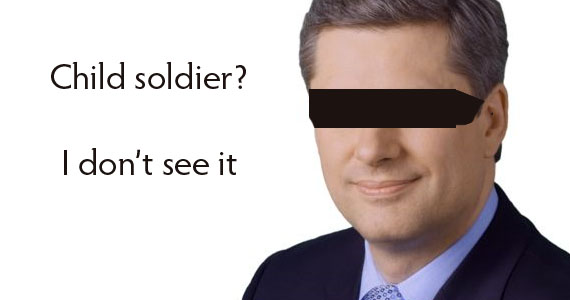

Again, I know my outlook is idealistic as I am assuming that people are fundamentally good and only need to be informed of an injustice in order to correct it, but I strongly believe that most people have a moral sense that won’t let them ignore wrong-doing for very long. Right now, educating U.S. citizens about the problem and having them pressure the government into action appears to be best way of making our country’s politicians do something.

Tuesday, April 13, 2010

Interview with a Female Child Soldier

I found this heartbreaking video on Youtube and had to post it. As a girl, I can relate much more to a female point of view and am interested in the unique problems that girls face in this atrocity. So far, I haven't been able to find that much information on girl soldiers, even though they make up forty percent of the kids in these armies. I think this is because not as many females are physically fighting. A lot of them serve as sex slaves. Personally, I find being a sex slave to be just as emotionally scarring as combat, but girl soldiers still don't get the media attention they deserve.


The Recruitment and Roles of Children in Fighting Forces

In chapter three of the book War and Children, authors Kendra Dupuy and Krijn Peters discuss the recruitment and roles of children in fighting forces. They bring up some very good points that usually aren't discussed. One of these points is how some child soldiers aren't forced to fight. Some enlist themselves because they feel like they have no other way to provide food and shelter for themselves. Some may argue that the children in this particular situation don't need to be rescued because they have made the choice to fight themselves, however, I strongly disagree. These kids may have enlisted themselves, but many of them made that decision because they had no other way to ensure they would receive food and water to keep themselves alive. They were thinking of their immediate physical needs and how to live for another 24-hours. You can't hold a kid accountable for a decision like this. They don't have a developed sense of their own mortality yet. Even in battle, the the adult soldiers give them so much weed and alcohol that they are not in their right mind and they think they are invincible. That is why in the United States we don't let children drink alcohol or join the military; they can't make responsible, informed decisions yet.
These authors also discuss another important topic: female child soldiers. Young girls make up almost half of all child soldiers. While some serve as sex slaves, others fight and even hold commanding ranks. Some of these girls have also entered into the forces voluntarily, however, a lot of them were lied to about what their positions would be. Most sex slaves are told they will be cooking meals or carrying guns for the other soldiers. The position of the female child soldier is especially saddening to me as a woman. These girls are raped multiple times a day. Almost all of them get STDs from their rapists, especially when their rapists have had several sex partners and sex victims. Some of them even get pregnant from the rapes and either have to raise a baby produced by rape or kill or abandon their own child. I cannot imagine the psychological damage done to these children.

Monday, April 12, 2010

Institutionalized Child Abuse

This journal article by Carrie E. Kimmel and Jini L. Roby discusses different problems that help facilitate the use of child soldiers. It talks about how children are used, either by their own government or by rebel forces, to further a political agenda. In countries that use child soldiers, there is generally a lack of governmental policies or poor enforcement of these policies. Small villages aren't likely to fight back against a powerful militia because they would be afraid that it would result in even more deaths.
Sometimes, however, these children aren't kidnapped. Some families offer up their children, especially for suicide missions where they will be martyred because it is seen as honorable for them to fight or die for a certain cause or because their religion glorifies martyrdom. If children aren't forced by their parents or by the militia, they are easily manipulated to join these forces.
It seems like no one is trying to end this horrific practice. The citizens of these countries can't be blamed too much. A lot of them aren't educated and don't have much influence on their government. Many of these countries governments could be doing much more to end this practice, but some of the countries governments are involved in the recruitment of these kids. It seems as though it is up to foreign actors, governmental organizations and NGOs to end this atrocity. I firmly believe that outside countries, especially powerful countries like the U.S., can end or greatly reduce the use of child soldiers. If the topic got more attention then more people would pressure their home government to act and eventually foreign governments would have to do something about the problem. Call me naive or idealistic, but I refuse to think that nothing can be done.

Wednesday, March 24, 2010

Math Lesson of the Day: The Value of Child Welfare < The Value of a Wii System

This article states why the country with the world's largest number of child soldiers, Burma, has been given a free pass to continue their crimes against humanity. The United Nations Secretary General has identified the Burman Military as one of the world's worst perpetrators of child recruitment, however, after a formal review of Burma's violations, the Security Council's recent report fails even to acknowledge that Burma's army recruits children. This seems odd, considering the Security Council's tough reputation. The Security Council threatened sanctions against the Tamil Tigers for the group's use of child soldiers. In the Democratic Republic of Congo, it referred information on violations to sanctions committees and urged the arrest and prosecution of commanders responsible for child recruitment. This group isn't soft, so why is it letting Burma off without anything? The answer is simple: China is a close ally with Burma and their military regime. China isn't exactly known for an impeccable human rights record, so its no surprise that they aren't too concerned with the country's use of child soldiers. It looks as though, because of the UN's dependence on China economically, they won't be doing anything to end the atrocities against the children of Burma. Maybe I'm just a big ole' softy about the Burman children, but I see something morally wrong with ignoring the fact that they are being used to fight a war. I don't understand how our Security Council can sleep at night knowing that they are allowing thousands of kids to die just so they don't risk damaging their relationship with China. I know particuliarly for the US, we trade a lot with China and China loaned us a lot of money recently. And, let's face it, they have a huge army with nuclear missles, but I think we are overestimating their reaction. I'm not saying China will be thrilled with the UN criticizing their ally, but I don't think they'll refuse to trade or go to war with the countries condemning Burma about it. If a bunch of countries banded together, China would lose too much money from not trading and they would have too many countries to go to war with. Even if they decided to do such a thing, they would at least give a warning and a chance for the offending countries to back off Burma. If we didn't want to look so cowardly by obeying China's commands, the UN could ask China beforehand if we put pressure on Burma to stop using child soldiers if they would stop trading with us. If they said yes, we could pretend that we had multiple reasons for not condemning Burma and back off for a little while. We have options. I guess the Security Council is afraid that if they recognize that Burma uses child soldiers and doesn't do anything about it, they would look bad. Not helping these kids is bad enough. Saying there isn't a problem is an even bigger slap in the face.

Sunday, March 21, 2010

Invisible Children

Invisible Children is a global, social, and political movement created to bring attention to the use of child soldiers in Uganda. The Lord's Resistance Army, a group of militant rebels, have been snatching children from their homes and forcing them to fight their war for twenty-three years. Invisible Children brings global attention to this atrocity by their radical campaigns. For instance, on April 25 last year thousands of people traveled by foot to a location in a city they claimed as their ‘LRA’ base, where they refused to leave until a senator, politician or public figure ‘RESCUED’ them by making a public statement on behalf of child soldiers. Invisible Children also helps Ugandans in ways that get less global attention. They rebuild schools, help educate future leaders and provide jobs to civilians.
Invisible Children is a great program. As far as I know, they are the most effective NGO targeting this issue. However, this movement could stand to expand. The only kids they are reaching are Ugandan children. There are at least two dozen countries in the world using child soldiers in either their government's military or the rebel forces. I don't understand why this program is so focused on Uganda when there are countries like Burma who are currently using far more child soldiers. I don't know what the answer to this problem is. Maybe we need a separate program like Invisible Children in every offending country. Maybe one program can't handle it all and that's why Invisible Children only focuses on Uganda.

Sunday, March 7, 2010

The Coalition to Stop the Use of Child Soldiers

This website "works to prevent the recruitment and use of children as soldiers and to secure their demobilization." It does this by producing facts about child soldiers, giving updates on recent developments, and providing details of international standards on children and armed conflict. The idea is that if people knew what was going on with these children, they would work to stop it. The website gives information on how you can get involved by making donations to the Coalition to Stop the Use of Child Soldiers, sign up your organization to your national coalition, or work with the coalition itself as a paid staff member or volunteer.
I like to believe that this website is right in its assumption that people only need to be informed of an injustice in order to correct it. I think that the reason why not much is being done currently about this issue is because not enough people know the problem exists. Up until recently, I thought Uganda was the only country using child soldiers. A year ago I didn't even know countries were still using kids in battle. As soon as I found out, however, I donated some books to my friend's high school who sent the school supplies to a Ugandan schoolhouse. I don't tell you this to brag, I am telling you this because it illustrates my point. As soon as I was informed of the problem and given a chance to do something, I acted. I realize that some people will decide not to do anything, but others will go the extra mile to heavily impact the cause once they are informed. Some people will join the peace corps or adopt a kid in a war torn country that is known for using child soldiers. We need to give people the opportunity to make a difference.